




Property management turnover is high because the job combines relentless inquiry volume, after hours emergencies, fragmented software, and flat career paths, and the fastest way to reduce it is to remove the workload that burns managers out rather than simply paying people more to endure it. Annual turnover across rental housing sits at 32.7 percent according to the National Apartment Association, and the U.S. Bureau of Labor Statistics projects roughly 29,100 community association manager job openings every year, most of them created by people leaving the role. This article breaks down what drives that churn, what a departure really costs a management company, and how AI assistants like Stan's homeowner assistant and the newly launched Manager AI attack the root cause: the workload itself.
How bad is turnover in property and community management?
Turnover in this industry runs two to three times higher than the U.S. average across all sectors. The National Apartment Association reports 32.7 percent annual turnover across rental housing, with maintenance roles at 39.2 percent and leasing positions near 32 percent.
On the community association side, a joint survey by AvidXchange and the Community Associations Institute (CAI) found that recruiting talent (50 percent) and mitigating staff burnout and retention (47 percent) were the top two challenges facing community association management companies. The pipeline problem is not new either: as far back as December 2020, the Foundation for Community Association Research found that 63 percent of management companies already had open community manager positions, and 97 percent of CEOs and hiring managers believed there was a shortage of community managers. Five years later, the industry is still recruiting from the same shallow pool.
The macro picture makes it worse. Eagle Hill Consulting's 2025 Workforce Burnout Survey found that 55 percent of the U.S. workforce reports burnout, and burned out employees are nearly three times more likely to say they plan to leave their employer within a year. Community association managers (CAMs) and property managers sit squarely in the highest risk category: frontline, customer facing, and perpetually understaffed.
Meanwhile, 92 percent of community association management companies planned to grow their portfolios in 2025 and 2026 according to Buildium's industry report. Growth ambitions are rising at the exact moment the people needed to deliver that growth are walking out the door.
Why do community association managers keep quitting?
Managers quit because the structure of the job is unsustainable, not because they dislike the work. Five drivers show up consistently in exit interviews, industry research, and the hundreds of conversations we have with management companies:
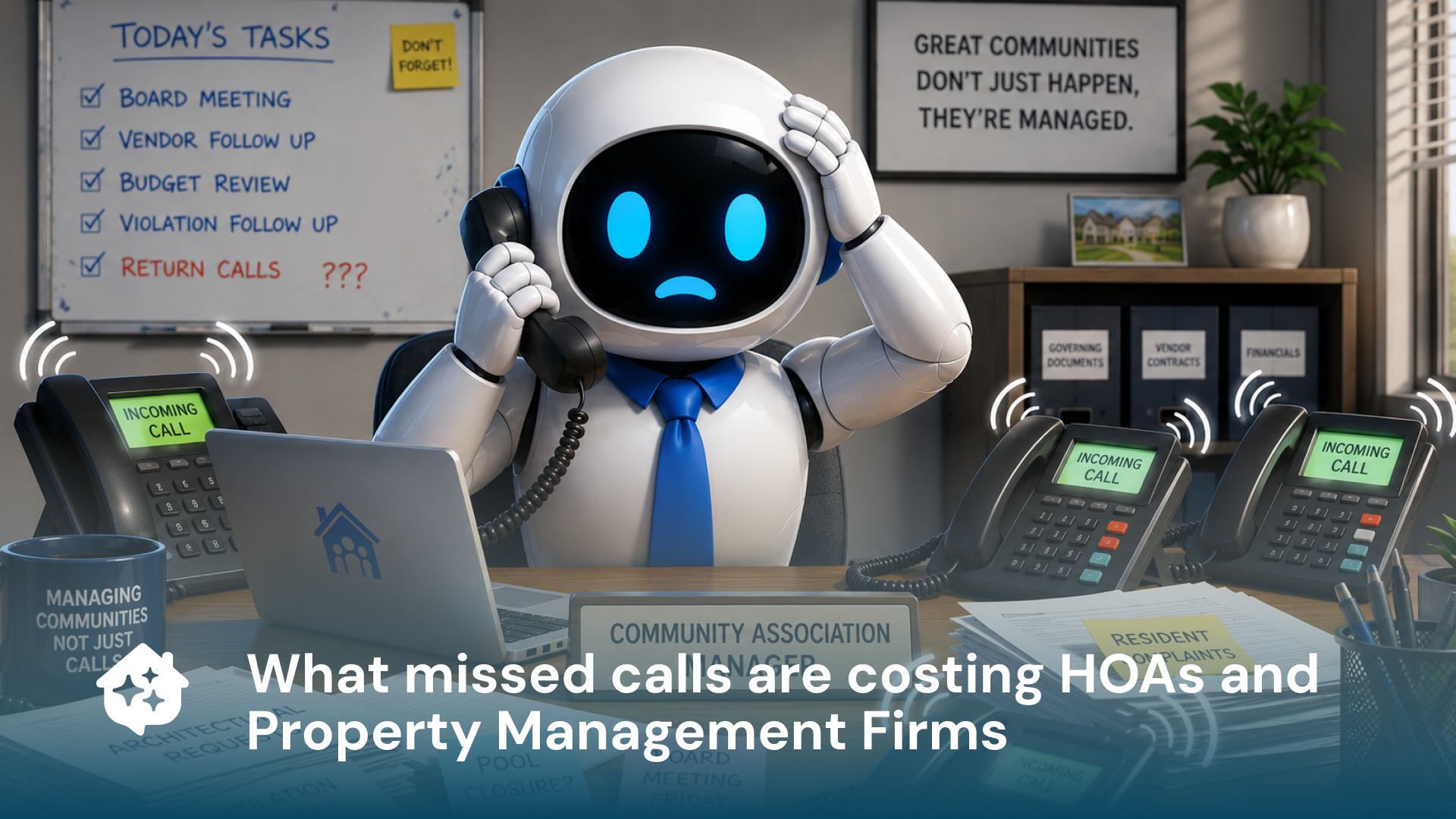
Inquiry overload. A single CAM can field dozens of calls, emails, texts, and portal messages a day, most of them repeat questions: What is my balance? When is the board meeting? Can I paint my fence? One operator we work with counted 56 missed calls in a single day before automating. Every missed call becomes a callback, an escalation, or an angry homeowner.
The always on expectation. After hours emergencies, weekend board meetings, and residents who expect instant answers mean the workday never truly ends. Vacation becomes a liability because the inbox that greets you on return erases any rest you got.
Fragmented technology. The average manager toggles between a property management system (Vantaca, CINC, AppFolio, Buildium, or similar), an email inbox, a shared drive or SharePoint, a calendar, spreadsheets, and a resident portal. None of these tools talk to each other, so the manager becomes the integration layer, copying and pasting data all day.
Blame without support. When something goes wrong, whether a missed violation notice or a delayed ARC approval, the manager is the face of the failure to both the board and the resident, even when the real cause was an impossible workload.
Flat career paths and modest pay. With average CAM base salaries hovering in the mid fifty thousands against a workload that resembles three jobs, many talented managers conclude the math simply does not work.
What does losing a manager actually cost?
Losing one portfolio manager typically costs a management company between one half and two times that person's annual salary once you account for recruiting, onboarding, and lost productivity, based on widely cited Gallup research on replacement costs. For community association management specifically, the damage compounds in ways a generic HR calculator misses:
- Immediate portfolio chaos. A departing manager takes institutional knowledge of every community, vendor relationship, delinquency history, and open ARC request with them. The replacement inherits a black box.
- Contract risk. Boards hire management companies for continuity. Repeated manager changes are one of the most common reasons associations put their contract out to bid.
- Team contagion. The remaining managers absorb the orphaned portfolio, their own burnout accelerates, and one departure becomes three. Operators describe this to us in almost identical words: one person leaves and it turns into a very big problem.
- Growth paralysis. You cannot pitch new communities while your existing book is on fire. Every hour spent on transition triage is an hour not spent on business development.
Can better pay and perks fix turnover on their own?
No, and it is worth being honest about this. Raises, wellness stipends, and flexible schedules all help at the margins, and companies should absolutely pursue them. But compensation adjustments do not change the underlying equation: one human being cannot personally answer 200 inquiries a week, chase 90 day delinquencies, reconcile budgets, compare vendor bids, prepare board packets, and respond to after hours emergencies without breaking. Research on burnout consistently points to workload as the primary driver, and workload is a systems problem. If the work itself does not change, higher pay just means renting the burnout cycle at a higher price. The durable fix is removing work from the manager's plate.
How does AI reduce turnover in property management?
AI reduces turnover by attacking the two biggest workload categories directly: repetitive resident communication and repetitive back office tasks. In practice this happens in two layers.
Layer one: deflect the inquiry flood before it reaches your team. An AI homeowner assistant answers resident calls, emails, texts, and web chats around the clock, pulling live data from your management software to resolve questions about balances, payments, meeting schedules, governing documents, ARC requests, and work orders. Stan was built on the principle that roughly 90 percent of homeowner inquiries can be resolved by AI, leaving the 10 percent that genuinely require human judgment, empathy, or authority to your managers. When the phones stop ringing, the single largest source of daily interruption disappears, and managers can finally do the strategic work they were hired for.
Layer two: compress the back office work that fills nights and weekends. This is where Manager AI, the newest addition to the Stan platform, comes in.
What is Manager AI?
Manager AI is a dedicated AI workspace for community and property managers that connects the tools you already use, your inbox, calendar, SharePoint, and management software, and executes multistep work on your behalf inside one place. Instead of a chatbot that answers questions, it functions like a digital teammate with its own file system: it can read documents, create files, run research, and move work between your connected systems, with a human approval step before it touches your management software.
Here is what that looks like on real tasks that eat manager hours today:
- Portfolio transitions. A newly assigned manager can ask for a full association rundown, delinquency status, open ARC applications, work orders, vendor details, and a 30 day action plan, delivered as a ready made PowerPoint pulled directly from the management software. What used to take a week of digging happens while you get coffee.
- Vendor bid comparison. Point Manager AI at the unread email containing landscaping quotes and it extracts the attachments, builds a comparison in Excel, and flags the lowest price, the strongest sustainability option, and a balanced recommendation.
- Collections workflows. Pull the top delinquent owners for a community, then generate a collections letter that cites the relevant state statute, whether that is Texas Property Code, Minnesota collections law, or Florida Statute 720, and email it to accounting for review.
- Budget season. Feed it your reserve study, contracts, and prior year figures from SharePoint and it drafts a working budget in Excel with line items, monthly assumptions, and sourcing notes for you to refine.
- Reusable workflow recipes. Once you like how a task ran, save it as a workflow and share it with your team, so your best process becomes everyone's default process instead of tribal knowledge that leaves when someone quits.
That last point matters more than it sounds. One of the hidden costs of turnover is that processes live in people's heads. Manager AI turns individual know how into saved, shareable workflows, which means a departure no longer erases the playbook.
How do you introduce AI without scaring your team?
Position AI as an assistant that removes the worst parts of the job, never as a replacement, and let your managers see the benefit inside their first 30 days. The managers most anxious about AI are usually the ones drowning hardest, and the fastest way to convert skepticism into advocacy is a quick, personal win: the phone that stopped ringing during dinner, the board packet that built itself, the transition that did not consume a weekend. A few principles that consistently work:
- Keep humans in the loop by design. Stan escalates sensitive or uncertain inquiries to your team rather than guessing, and Manager AI asks for approval before acting in your management software. Managers stay in control; they just stop doing the grunt work.
- Train the whole team from day one. Implementation should include hands on training so your staff are experts on the platform, not bystanders to it.
- Measure what managers feel, not just what finance sees. Track calls and emails deflected, hours returned per manager, and response times alongside cost per door. Retention follows workload relief.
Frequently asked questions
What is the average turnover rate in property management?
Annual turnover across rental housing is 32.7 percent according to the National Apartment Association, with maintenance roles reaching 39.2 percent. That is roughly double the average across all U.S. industries. On the community association side, 63 percent of management companies reported open community manager positions in a Foundation for Community Association Research survey.
Why is burnout so common among community association managers?
CAMs juggle constant resident inquiries, after hours emergencies, board demands, and a fragmented software stack, often across a dozen or more communities at once. Workload, not lack of commitment, is the primary driver, which is why staffing changes alone rarely fix it.
Does AI replace community association managers?
No. AI tools like Stan resolve the roughly 90 percent of routine, repetitive inquiries and tasks, while managers handle the complex, sensitive, and relationship driven work that actually requires human judgment. The goal is fewer resignations, not fewer managers.
How is Manager AI different from a chatbot?
A chatbot answers questions. Manager AI executes work: it connects to your inbox, calendar, SharePoint, and management software, creates files like budgets, board decks, and comparison spreadsheets, and completes multistep workflows with human approval checkpoints.
How quickly can a management company implement an AI assistant?
Stan implementations typically take about three weeks, including connecting your management software and knowledge base and training your team on the platform.
The bottom line
Property management turnover is not a hiring problem you can recruit your way out of. It is a workload problem, and workload problems require workload solutions. Companies that pair a 24/7 homeowner assistant with Manager AI give their people back the hours, sleep, and sanity that keep them in the industry, and give themselves a durable edge when pitching boards who are tired of meeting a new manager every year.
Ready to see what your managers' week looks like when the busywork disappears? Book a demo of Stan and Manager AI and watch it run on your own portfolio.

.png)