Mehak Khattar

At 4:20 PM UTC on Thursday, November 12, Microsoft Exchange Online began failing. For most of the next 24 hours, people across North America could not open Outlook, and email that did get sent sat in delayed queues. Microsoft did not declare the incident resolved until Friday afternoon.
For most businesses, that was an inconvenience. For community managers, it was something closer to a blackout. Email is how many associations send assessment reminders, maintenance notices, board updates and emergency alerts. When it stops, the questions from homeowners don't.
This was not a cyberattack. According to Microsoft's preliminary post incident report, a software defect that had been quietly deployed months earlier collided with a surge in traffic and reduced server capacity. The failure cascaded from server to server, and at its worst more than 80% of the affected servers stopped responding. Recovery took longer than usual because servers brought back online were immediately overwhelmed again.
That detail matters. Nobody did anything wrong at the management company level. You can follow every best practice and still lose your main channel for a day because of a bug inside a provider you don't control.
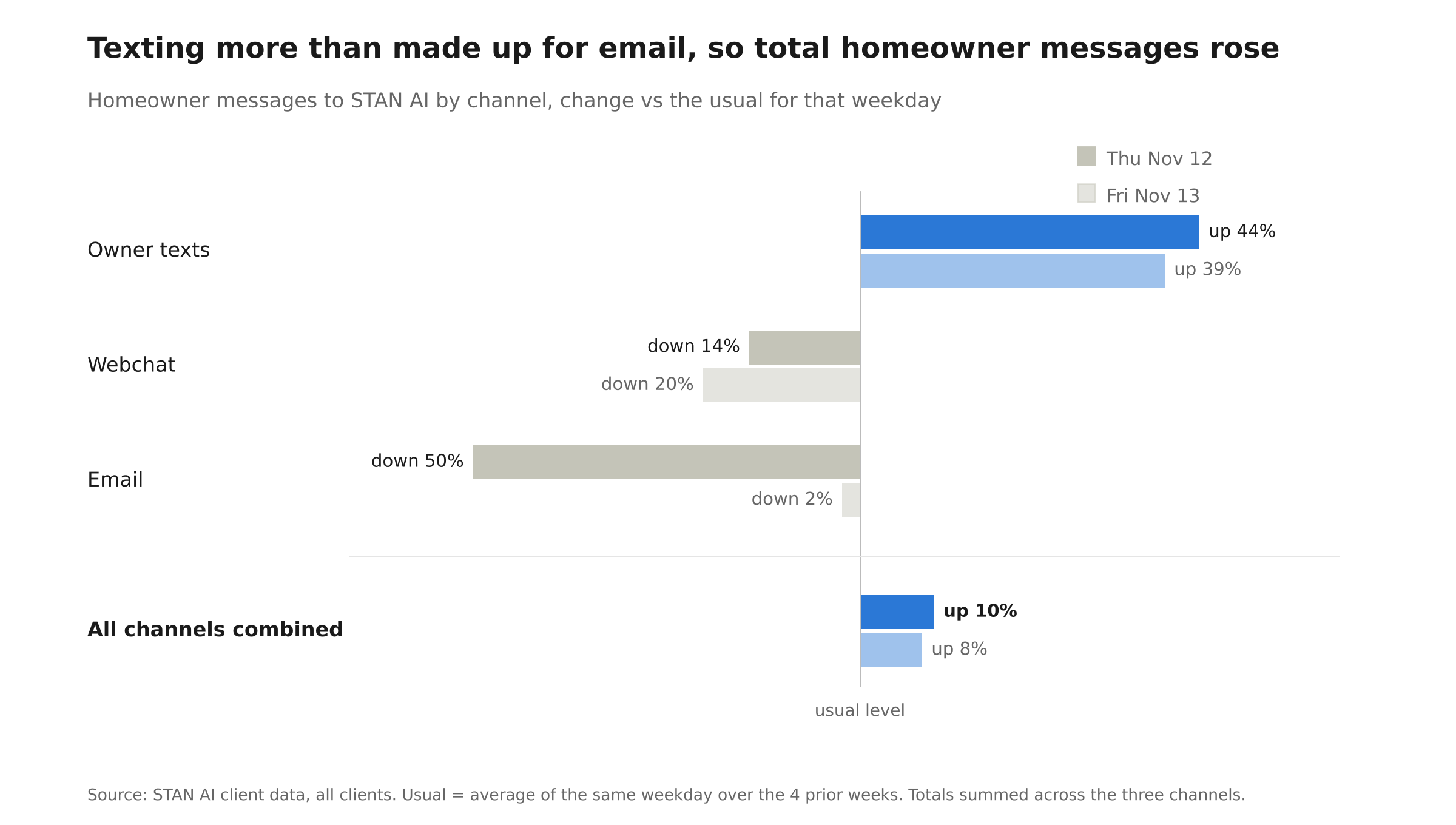
STAN AI gives managers several ways to reach and hear from homeowners: text, voice, email and webchat. During the outage, we watched what managers and homeowners did when email stopped working.
The last point is the one we keep coming back to. Homeowners did not go silent when email failed. They talked to their communities more, because something was going on and they had a channel that still worked.
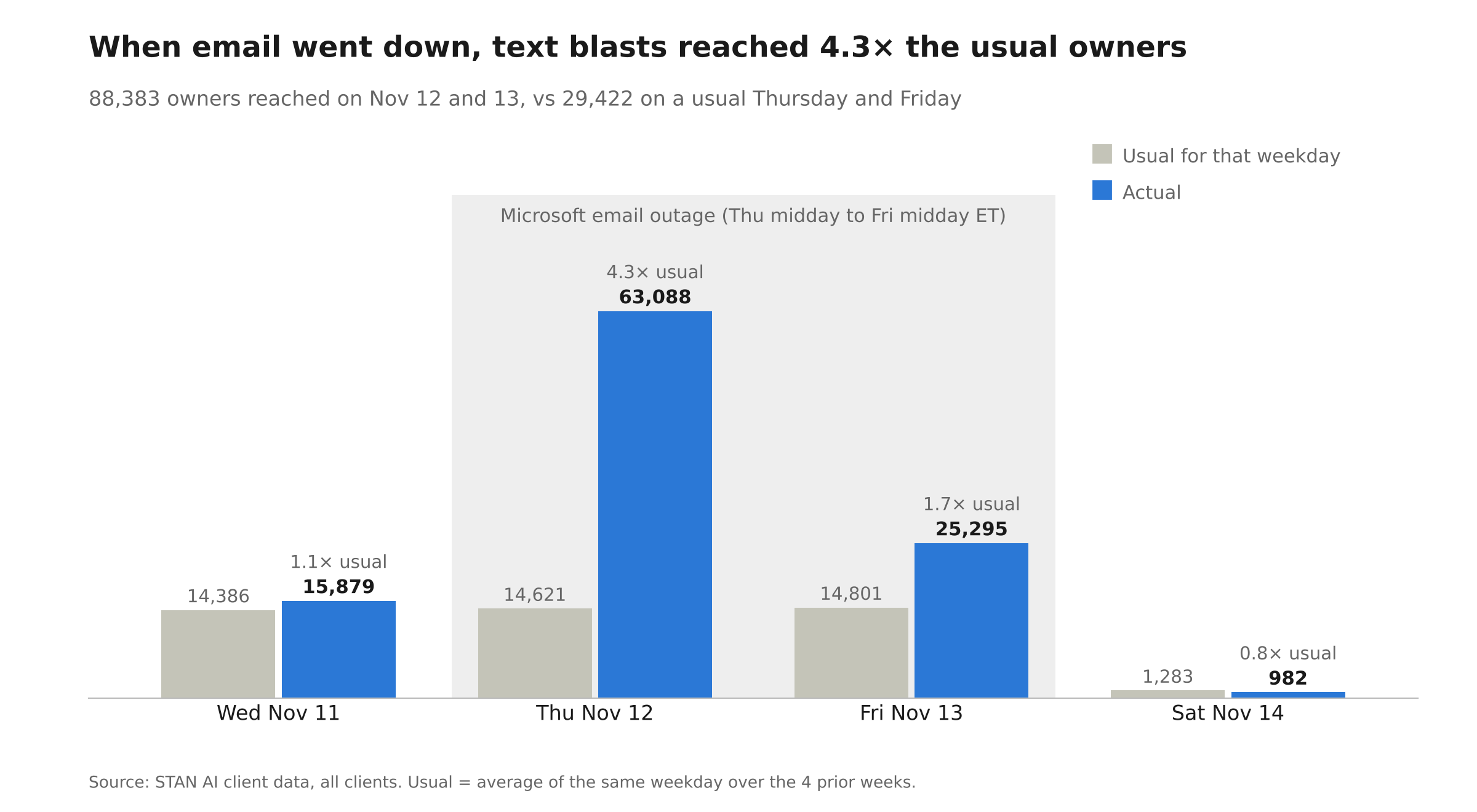
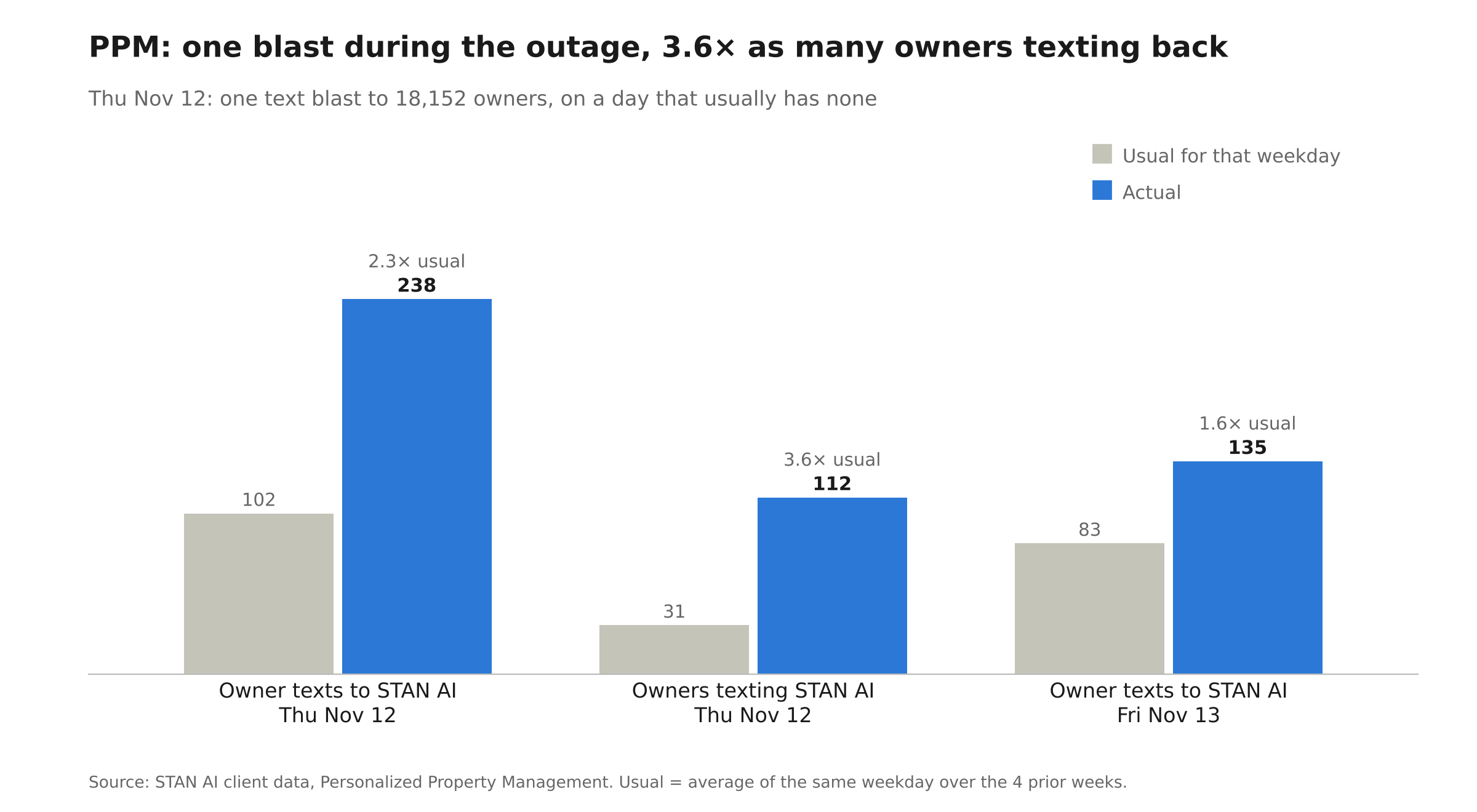
Personalized Property Management (PPM) normally sends no text blasts on a Thursday. On November 12, with email down, they sent one to 18,152 owners.
The response was immediate. Owner texts to STAN AI more than doubled that day, from a usual 102 to 238. The number of individual owners texting rose from 31 to 112, more than three and a half times normal. On Friday, owner texts were still up, at 135 against a usual 83.
PPM didn't have to wait for Microsoft. Their homeowners got the information they needed on the same day the outage started.
The Microsoft incident was a bug. The next disruption may not be. In 2026 alone, ransomware groups have publicly claimed attacks on several US property and association management firms, and at least one community management company has confirmed a ransomware breach in filings with state regulators.
Whether the cause is a provider outage, a ransomware attack, a phishing compromise or a storm that knocks out power and internet, the result for homeowners looks the same: they can't reach you, and you can't reach them. The communities that come through it well are the ones that planned for it before it happened.
You can't control when a provider goes down or when someone targets your systems. You can control whether a single failure leaves your homeowners in the dark. Last week, the managers who had a second channel used it within hours, and their homeowners responded.
If your community relies on one channel today, now is the time to fix it, not during the next outage.