



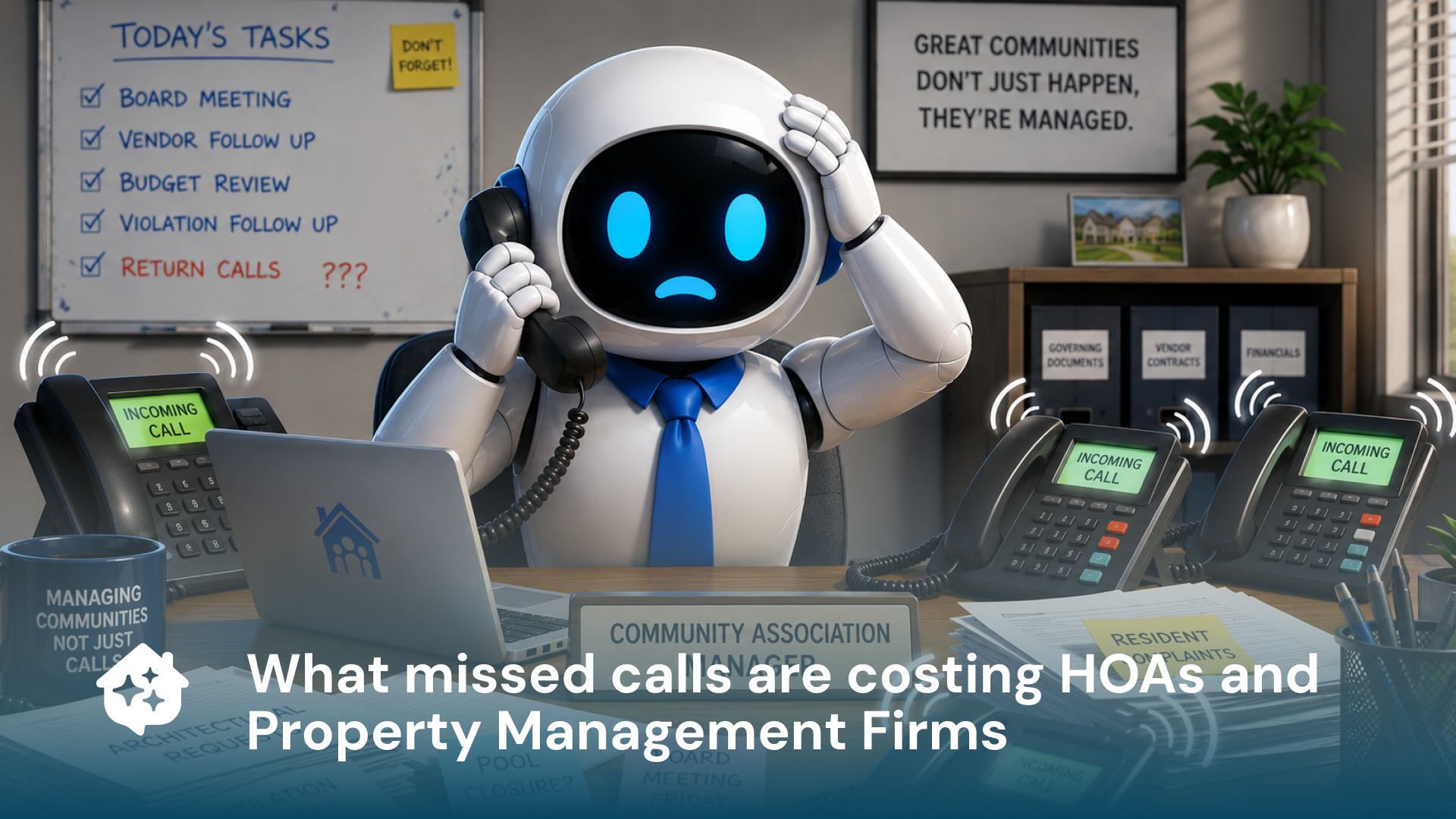
Property management companies miss more inbound calls than almost any other industry. Call analytics research aggregated from ServiceTitan, BIA/Kelsey, Invoca, and 411 Locals shows that small businesses answer only 37.8% of incoming calls, and property management firms sit above that average with more than 60% of calls going unanswered. Of the callers who reach voicemail, roughly 85% never call back. For the average small service business, that translates to about $126,000 per year in lost revenue. For an HOA management company, the damage runs deeper than lost revenue: unanswered homeowners escalate to boards, boards reconsider management contracts at renewal, and in a growing number of US states, homeowners who cannot get a response have a legal path to force one, complete with statutory penalties that land on your client association and, by extension, on your desk.
This article breaks down what missed calls actually cost a management company, why the industry is hit harder than most, and what homeowners can legally do in each state when their HOA goes silent.
How many calls do property management companies actually miss?
Industry call tracking data consistently places property management among the worst affected sectors, with missed call rates above 60%, higher than healthcare (around 34%), legal (around 35%), and most home services categories. The structural reasons are obvious to anyone who has run a portfolio: managers are on site, in board meetings, or already on another call, and a large share of homeowner calls arrive outside office hours. Across industries, roughly 45% of high intent calls come in evenings and weekends, when most management offices route everything to voicemail.
Voicemail is not a safety net. Between 80% and 86% of callers who reach voicemail hang up without leaving a message, and when messages are left, the average small business takes 47 hours to return the call. In our own sales conversations with management companies, we have heard operators count more than 50 missed calls in a single day at one office. Most companies have no idea their number is that high, because a call that rings out leaves no ticket, no log entry, and no trace.
What does a missed call actually cost a management company?
The direct math is straightforward. Take a mid sized firm managing 5,000 doors that receives 100 calls a day. At a 60% miss rate, that is 60 unanswered calls daily. Most are routine homeowner questions, but even if only 2 or 3 per day are new business inquiries, board members evaluating a switch, or emergencies that turn into insurance claims when nobody picks up, the annual cost is substantial. Benchmarks across service industries put the average value of a missed call at $100 to $200, and aggregate estimates put annual losses for a typical small service business at $126,000. Busier firms with higher contract values lose more.
For HOA management specifically, the unit of loss is not a single job, it is a community contract. A 250 door community at $12 to $15 per door per month is worth $36,000 to $45,000 a year, often on multi year terms. One frustrated board president who called three times during a plumbing emergency and got voicemail each time does not cost you $150. They cost you the renewal. And because 62% of callers who cannot reach a business contact a competitor instead, the same missed call that loses your contract often hands it directly to the rival management company pitching your board next quarter.
There is also a compounding reputation cost. Analysis by SwingPoint Media found that 37% of one star reviews for local businesses specifically cite missed or unreturned phone calls, not service quality or pricing. For a management company, those reviews show up when the next prospective board googles you during an RFP.
Why are missed calls a legal risk for HOAs and their management companies?
Because in most states, silence from an HOA is not just bad service, it is a statutory violation with deadlines, penalties, and escalation paths written into law. When a homeowner sends a written request and hears nothing, a growing body of state law lets them impose per day fines on the association, file complaints with state regulators, or take the association to small claims court with attorney fee shifting. The association is the named party, but the management company fields the fallout: the demand letters, the regulator correspondence, the emergency board calls, and eventually the question from the board about why they are paying a professional manager to generate legal exposure.
Two things are worth being honest about here. First, most of these statutes govern written records requests and formal inquiries, not everyday phone calls. No state fines an HOA $50 a day for missing a phone call. But in practice, the escalation almost always starts with unanswered calls: a homeowner calls twice, gets voicemail, gets angry, and then sends the certified letter that starts a legal clock. Missed calls are how routine questions become statutory disputes. Second, the strength of these laws varies enormously by state, and several states have essentially no HOA specific framework at all. The table below reflects that honestly rather than pretending all 50 states give homeowners equal leverage.
What can homeowners legally do, state by state, when their HOA doesn't respond?
The table below summarizes the states with the strongest and most clearly defined mechanisms. Statute numbers retain their official formatting. This is general information, not legal advice, and legislatures amend these laws frequently, so verify current statutes before relying on them.
How do missed calls affect winning and keeping community contracts?
Responsiveness is the single most inspectable thing a board evaluates. A prospective board cannot easily audit your accounting quality or vendor management before signing, but every board member has personally called your office, and every homeowner in the community reports their experience at the annual meeting. Research on lead response shows 78% of buyers choose the vendor that responds first, and phone leads convert at roughly 10 times the rate of web forms. In an industry where growth means winning community contracts against two or three rival firms pitching the same board, the firm that answers at 9 pm on a Saturday has a differentiation story the others cannot match.
The margin angle matters just as much. The traditional fix for call volume is headcount, and adding staff to keep up with portfolio growth erodes the per door margin that made the growth worthwhile. The operators we talk to describe it plainly as an ugly cycle: win doors, hire admins, watch margin flatten, repeat.
What are the options for fixing missed calls?
There are four realistic paths, each with honest tradeoffs. Hiring more front desk staff works but costs $40,000 or more per seat annually and does nothing after 5 pm. Traditional answering services cover after hours but can only take messages, which still leaves the homeowner without an answer and your team with a callback queue. Call overflow routing to managers' cell phones spreads the pain rather than removing it, and it is a documented driver of manager burnout and turnover. The fourth option is AI assistants purpose built for community management, such as STAN, which answer homeowner calls, emails, and chats around the clock, resolve routine questions like assessment balances, amenity rules, and architectural request status directly from association records, and escalate the genuinely complex or sensitive conversations to a human manager. The right choice depends on portfolio size and call mix, but the wrong choice is the default one: letting 6 out of 10 calls ring out and assuming voicemail is catching what matters. The data says it is not.
Key takeaways
- Property management companies miss over 60% of inbound calls, one of the highest rates of any industry, and 85% of missed callers never call back.
- Benchmarks put the average annual cost at $126,000 for a small service business, but for management companies the real unit of loss is the community contract, worth $36,000 to $45,000 a year for a typical 250 door community.
- Missed calls are the on ramp to legal escalation: states including California, Florida, Texas, Arizona, and Colorado impose statutory response deadlines with per day penalties, and seven states operate HOA ombudsman or complaint offices.
- 62% of unanswered callers contact a competitor, meaning every missed call from a prospective board is a direct handoff to a rival firm.
- Fixes range from headcount to answering services to AI assistants; the only indefensible option is leaving the miss rate unmeasured.
FAQ
Do any states fine HOAs for missing phone calls?
No. Statutory penalties attach to ignored written requests, records demands, and formal inquiries, not phone calls. But unanswered calls are almost always the first step in the escalation that produces those written demands.
Which state has the strongest homeowner recourse against an unresponsive HOA?
Nevada and California are generally considered the strongest. Nevada lets a homeowner trigger a state investigation with a single free form (Form 530), and California pairs 10 business day deadlines with a $500 per request penalty and attorney fee shifting enforceable in small claims court.
Who pays the penalty when an HOA misses a statutory deadline, the association or the management company?
The association is the legally liable party in nearly all cases. But management contracts often assign responsiveness duties to the manager, and boards routinely treat statutory violations as grounds to terminate or decline to renew the management agreement.

.png)