



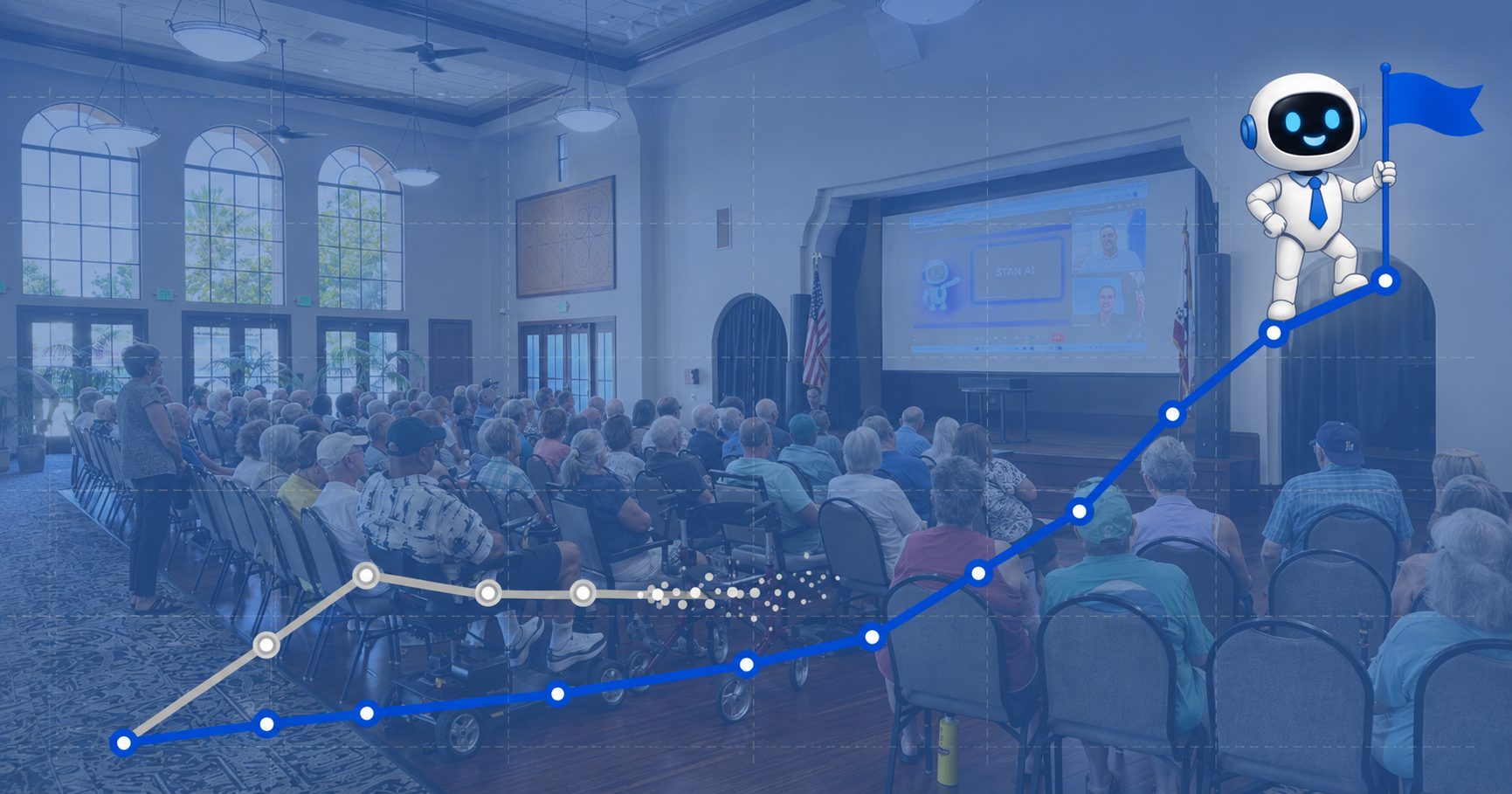
According to MIT research cited by Chronus, 95 percent of enterprise AI pilots fail to generate a return on investment. Only 5 percent succeed. The technology is rarely the problem: the organizations are simply not ready, and nobody prepares them. STAN AI was built to be the exception, because we treat adoption as part of the product, not an afterthought. Every STAN AI implementation includes structured training for management teams, community association managers, and the homeowners themselves, which is why our clients climb the adoption curve while most of the industry stalls at the bottom of it.
Why do most AI rollouts fail?
Most AI rollouts fail because companies buy technology and skip the people. BCG's December 2025 research found that 60 percent of companies globally generate no material value from AI despite substantial investment, and more than 85 percent of employees remain stuck in the earliest stages of adoption, using AI like a search engine rather than a true collaborator. The barriers BCG identified are strikingly human: lack of trust, no protected time to learn, and minimal guidance, with only 25 percent of frontline employees saying leadership shows them how to use AI effectively.
The burden of fixing this usually lands on the people least equipped to carry it. Harvard Business Review reported in June 2026 that middle managers absorb the hidden cost of AI adoption: validating outputs, catching errors, and coaching their teams on new skills, all while delivery pressure stays the same and formal support never arrives. In community association management, that middle layer is the CAM. When a vendor drops software on a portfolio and disappears, the manager becomes the unpaid trainer for an entire community.
What does the adoption gap cost management companies?
The adoption gap turns an investment into an expense. An AI platform that nobody uses still shows up on the invoice, but the call volume never drops, the after hours emergencies still land on a human, and the board asks why the promised efficiency never materialized. Chronus notes that only 44 percent of American workers report receiving AI training from their employers, even though roughly 80 percent are already using AI at work. That mismatch is exactly how software becomes shelfware: quiet underuse, followed by churn.
How does STAN AI close the adoption gap?
STAN AI closes the gap by training every layer of the community, not just the buyer. Implementation takes about three weeks and includes training the management team on the platform from day one. Then we go further than anyone else in the industry: our Customer Success team runs live workshops for the residents who will actually use STAN AI by webchat, text, and voice. MIT's data shows that the 5 percent of successful AI adopters work closely with their vendors during early deployment and integrate tools directly into daily workflows. That is our entire operating model. We also designed STAN AI around a 90/10 principle: the platform resolves routine homeowner questions while complex and sensitive matters route to the manager, preserving the human touchpoint that communities value.
What does real adoption look like?
Real adoption looks like a packed clubhouse in Sacramento. At Heritage Park Owners Association, a 55 and over community, residents filled the room for a STAN AI workshop hosted by our Customer Success team, learning to reach their association through the webchat in their Enumerate portal, by text, and by voice. Conventional wisdom said retirees would resist AI. Instead, they became some of our most engaged users, because someone took the time to teach them, and because the platform was built around what genuinely makes their lives easier.
Key takeaways
Most AI initiatives fail on adoption, not technology: 95 percent of pilots never produce ROI, and 60 percent of companies see no material value. The difference maker is human enablement, which is why STAN AI includes training for managers and homeowners in every implementation. When end users are taught well, adoption follows, managers are unburdened, and the platform pays for itself. Your AI should not be a subscription your team ignores: it should be a tool your entire community actually uses.


.png)